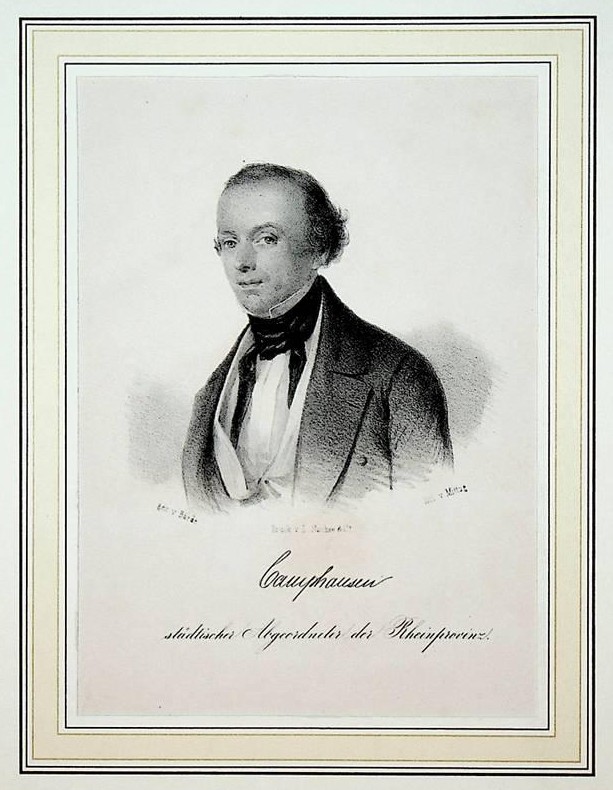
This essay is based directly on Dr. Alfred Krüger’s 1925 work titled Das Kölner Bankiergewerbe vom Ende des 18. Jahrhunderts bis 1875, published in Essen by G. D. Baedeker Verlag.
The relationship with the banking firm Camphausen runs through Rev. Antonius Quast, born in Odenkirchen, baptized in Wickrathberg on 19 July 1682, student in Duisburg on 19 September 1699, rector of the Latin school in Wickrathberg from 1710 to 1718, minister in Schwanenberg (Imperial Lordship connected with Wickrath) in 1718, died there between 26 May and 17 December 1751, married 1st in Wickrathberg on 16 January 1707 Agnes Camphausen, baptized in Wickrathberg on 15 June 1687, died after 12 October 1710, daughter of Claas and Dreutgen Schmasen; married 2nd in Wickrathberg on 4 December 1712 Johanna Elisabeth Herminghausen, born in Gladbach around 1688, church member in Gladbach on 1 April 1708, died in Schwanenberg on 4 December 1779, daughter of Rev. Johann Peter and Johanna Lüps.
The firm A. & L. Camphausen was established by the brothers August and Ludolf Camphausen, who originated from Hünshoven near Aachen. At the beginning of the 1820s, the brothers took over the operation of an oil mill and oil trading business in Hünshoven that had previously been run by their father. Recognizing Cologne’s growing significance on the Lower Rhine as a primary market and transshipment hub for grain and oilseeds, they decided on an early expansion of their inherited business and set up a branch in Cologne equipped with an oil mill in 1826.
Although established as a branch, the Cologne location quickly grew to become the main focal point of the entire enterprise and centered its operations on the grain trade. The young company received substantial momentum by developing close personal and commercial ties, particularly with the merchant firm Seydlitz & Merkens and its principal, Heinrich Merkens. By 1832, the Cologne Chamber of Commerce recognized A. & L. Camphausen as one of the most prominent wholesale merchant houses in the city.
Transition to banking and the pivotal shift of 1848
Following the shutdown of their original parent mill in Hünshoven during the 1830s, the Cologne firm gradually transitioned from pure physical commodity trading into general banking operations. This transformation combined merchandise trading with bill broking, securities trading, and securities issuance alongside modern corporate structures. Nevertheless, physical commodity inventories remained a primary structural element of the business throughout the 1840s.
A decisive structural turn occurred in 1848. Prompted primarily by the widespread economic hardship of the period, the brothers rapidly liquidated their substantial merchandise holdings, which consisted mainly of grain. The freed liquid capital was redirected into current accounts to meet the sharp increase in industrial and commercial demand for money and capital during the crisis. Following this transition, only a minor fraction of capital was reserved for occasional grain and oil transactions conducted on the bank’s own account.
Commercial and industrial current account financing
The current account business became and remained the primary investment focus for A. & L. Camphausen. Initially, it maintained traditional connections with wholesale trade in grain, oilseeds, oil products, colonial goods, and textile raw materials. The bank extended substantial drafting credit to facilitate import operations. Its acceptances were prominent in financing imports of Russian grain and Indian rapeseed, earning high trust and recognition among foreign partners, including Crédit Lyonnais and the London merchant house Horstmann & Co..
The bank’s current account facilities subsequently expanded into various regional production industries. In the milling sector, the firm supported flour milling enterprises in Cologne, such as Heinr. Auer, and in Neuss, including Rosellen & Co.. Its financing extended to the left-bank Rhine textile and paper industries located in Düren, Jülich, Rheydt, and Neuss, as well as to the emerging rubber manufacturing industry represented by Cologne firms like Franz Clouth and Friedrich Kohlstaedt.
Mining, metallurgy, and infrastructure investments
Starting around the middle of the 19th century, A. & L. Camphausen grew heavily involved in heavy industry and metallurgical production, maintaining ongoing banking arrangements with companies in which it held a direct or indirect founding role. In Ruhr and Cologne mining, the bank joined the founding consortium of the Kölner Bergwerks-Verein in the late 1840s. It participated in forming the Ruhrorter Bergwerks-Verein, which went into liquidation after its first five years, and in the early 1870s, it replaced the liquidating firm Seydlitz & Merkens in “Saturn”, Rheinischer Bergwerks-Aktienverein, Köln.
In the Lahn-Sieg and Nassau regions, the bank acquired iron ore concessions near Limburg an der Lahn, which were later integrated into the Krupp-dominated Gewerkschaft “Eintracht” at Oberbechem. It also fostered ongoing relations with the Sieg-Rheinischen Bergwerks-Verein, Kommandit-A.-G. in Cologne, the Neußer Bergbau- und Hütten-Kommandit-A.-G. in Neuss, and the Sieg-Rheinischen Bergwerks- und Hütten-Aktienverein in Cologne. On the left bank of the Rhine, the firm was instrumental in creating Concordia, Eschweiler Verein für Bergbau und Hüttenbetrieb in Aachen, which became one of the bank’s most prominent achievements and client accounts, while also aligning with cement production at the Bonner Bergwerks- und Hütten-Verein in Oberkassel near Bonn in the 1850s.
Long before its industrial financing peaked, the bank championed large-scale capitalist ventures in transport and insurance. It acted as an early promoter for major rail networks, including the Rheinische Eisenbahn-Gesellschaft and the Köln-Mindener Eisenbahn-Gesellschaft. It also supported steam shipping via the Kölner Dampfschleppschiffahrt-Gesellschaft and contributed to a project aimed at establishing a Rhine sea-shipping company. Although A. & L. Camphausen long resisted joining joint-stock credit banks, it eventually participated in the early 1870s in establishing the Elberfelder Wechsler- und Disconto-Bank and the Elberfelder Handels-Gesellschaft, securing representation on their supervisory boards.
Leadership, corporate structure, and capital constraints
Ludolf Camphausen provided the creative drive and intellectual direction during the bank’s formative period, intending to use the business as a vehicle to fulfill his broader economic and political vision. However, as his involvement in public, parliamentary, and state political affairs expanded during the 1840s, his active management ties to the firm steadily loosened, and operational control passed increasingly to his brother, August Camphausen.
This shift caused the bank to lose a critical part of its original momentum, preventing it from keeping pace with the rapid expansion of competing Cologne institutions. Although August Camphausen and his son Arthur Camphausen maintained the bank’s reputation and prestige in West Germany for decades, the firm’s growth was constrained by capital limits. By the end of the 1860s, the bank’s operating capital was estimated at approximately 2 million Taler—a total that the firm was unable to maintain in the following years.
Executive management and leadership chronology
The leadership of the banking house A. & L. Camphausen was guided by four key partners across its history. Ludolf Camphausen and August Camphausen both entered the enterprise as founding partners in 1826. Ludolf exited the management in 1868, whereas August remained active for several decades until his departure in 1883. In 1861, two additional family members joined the management board: Arthur Camphausen and Hermann Camphausen. Hermann Camphausen exited the firm alongside Ludolf in 1868, while Arthur Camphausen continued to direct the banking house until his departure in 1903.